Swallowing is something most of us do dozens of times a day without thinking about it. Food moves from the mouth into the food pipe, or esophagus, and then passes smoothly into the stomach. But when swallowing repeatedly becomes difficult, food feels as though it is getting stuck, or meals come back up after eating, it may be more than ordinary indigestion.
One condition that can cause these symptoms is achalasia cardia, a rare disorder affecting the movement of the esophagus. Fortunately, modern treatments such as Peroral Endoscopic Myotomy (POEM) have transformed the way many patients with achalasia can be treated.
What Is Achalasia Cardia?
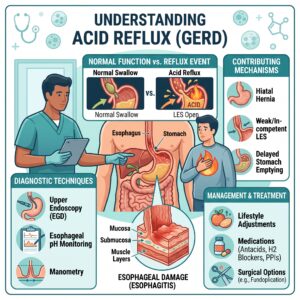
Achalasia is a disorder of the esophagus in which the muscles of the food pipe do not work normally and the lower esophageal sphincter (LES) does not relax adequately when you swallow. Normally, the LES opens to allow food and liquids to enter the stomach. In achalasia, this relaxation is impaired, while normal wave-like contractions of the esophagus are also reduced or absent.
As a result, food and liquids can remain in the esophagus instead of moving efficiently into the stomach.
This explains why a person with achalasia may say, “I can swallow the food, but it doesn’t seem to go down.”
Achalasia is a chronic condition. It is not simply a problem of eating too quickly or not chewing food properly. The underlying issue involves the nerves and muscles responsible for coordinated esophageal movement.
What Are the Symptoms of Achalasia?
Difficulty swallowing, medically called dysphagia, is usually the most important symptom. Unlike many other swallowing disorders, achalasia can cause difficulty with both solid foods and liquids.
Common symptoms include:
- Difficulty swallowing food or water
- A sensation that food is stuck behind the chest bone
- Regurgitation of undigested food or liquids
- Chest discomfort or pain
- Coughing, particularly at night
- Repeated throat clearing
- Unexplained weight loss
- Difficulty eating a normal meal
- Heartburn-like symptoms
Some patients also experience nighttime regurgitation. Because food can remain in the esophagus for prolonged periods, it may come back into the mouth when a person lies down.
This can be particularly troublesome and may interfere with sleep.
Why Is Achalasia Sometimes Mistaken for Acid Reflux?
One of the challenges with achalasia is that its symptoms can resemble gastroesophageal reflux disease (GERD).
A patient may experience chest discomfort, regurgitation, or a burning sensation and assume that the problem is acidity. They may start taking antacids repeatedly. However, if the symptoms continue despite appropriate treatment—or if swallowing progressively becomes difficult—another diagnosis should be considered.
Persistent difficulty swallowing should not simply be treated as acidity without evaluation.
An important clue is the nature of the swallowing problem. Patients with achalasia often have difficulty swallowing both liquids and solids, whereas many structural problems of the esophagus initially cause difficulty mainly with solid foods.
How Is Achalasia Diagnosed?
Diagnosis generally requires a combination of clinical assessment and specialized testing.
An upper gastrointestinal endoscopy may be performed to examine the esophagus and stomach and to rule out other causes of obstruction. A barium swallow or esophagram can demonstrate characteristic changes in the esophagus, including narrowing near the lower esophageal sphincter and dilation of the esophagus above it.
The most important test for confirming and classifying achalasia is high-resolution esophageal manometry. It measures pressure and muscle activity throughout the esophagus and helps identify the subtype of achalasia.
Doctors generally classify achalasia into three major types:
- Type I: Minimal or absent normal esophageal contractions.
- Type II: Abnormal pressure builds up within the esophagus.
- Type III: The esophagus develops abnormal or spastic contractions.
Identifying the subtype is important because it can influence treatment planning.
What Is POEM?
POEM stands for Peroral Endoscopic Myotomy.
It is a minimally invasive endoscopic procedure developed to treat disorders in which abnormal muscle contraction prevents food from passing normally through the esophagus. It is particularly important in the treatment of achalasia.
Unlike traditional surgery, POEM does not require a large external incision.
During the procedure, an endoscope is passed through the mouth into the esophagus. The doctor creates a small tunnel within the wall of the esophagus and carefully divides the muscle fibers responsible for the abnormal tightness. The treatment can extend through the lower esophageal sphincter and, when necessary, into the upper portion of the stomach.
The objective is straightforward: reduce the excessive resistance at the lower esophageal sphincter so that food can pass more easily into the stomach.